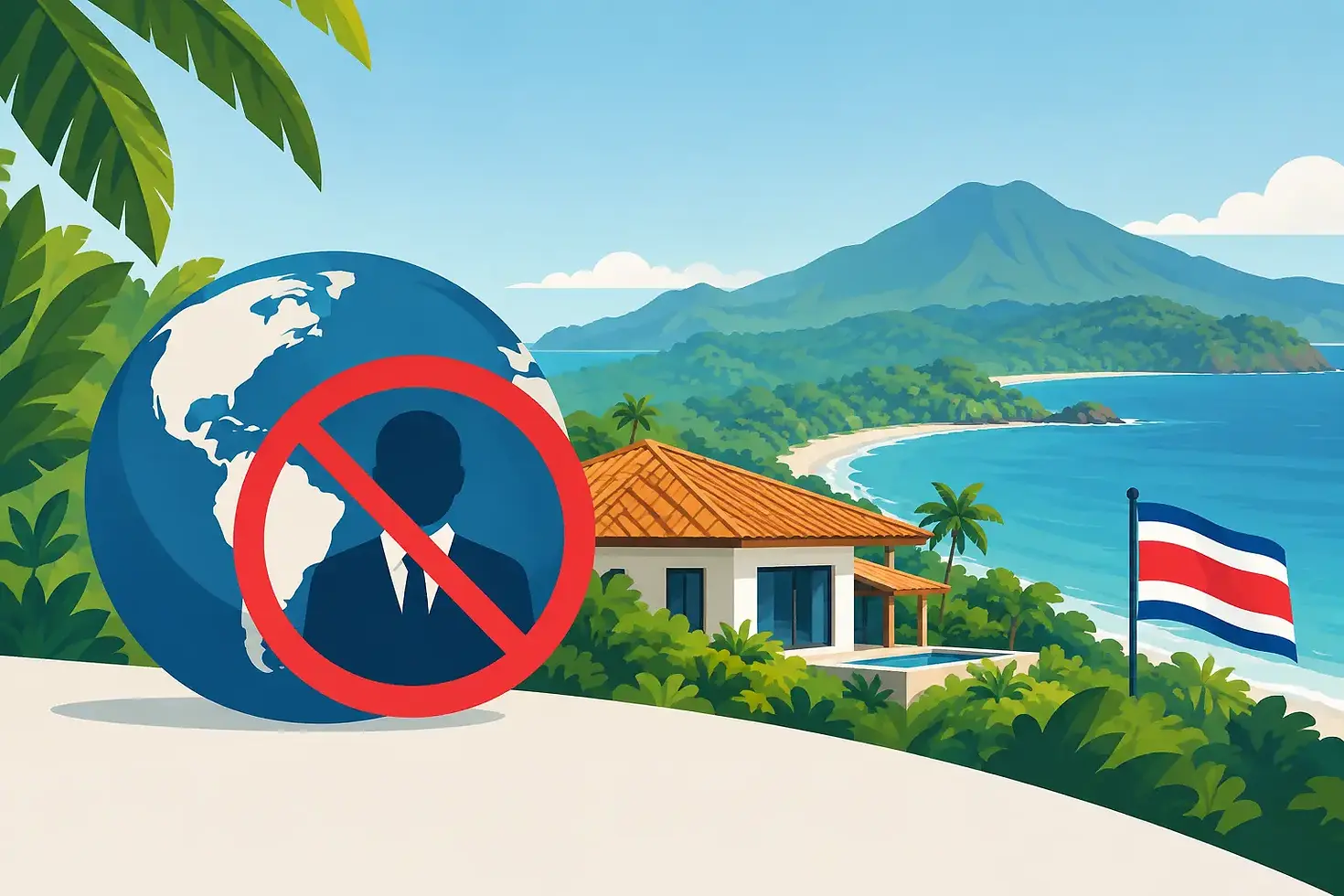
Foreign Ownership Restrictions in Costa Rica

A residence above the Pacific, a private estate near Playa Hermosa, or a considered parcel with mountain-to-ocean views can feel immediately personal. Yet before a buyer falls in love with the architecture, the beach access, or the promise of a Guanacaste legacy, one question deserves a precise answer: how do foreign ownership restrictions affect the property itself?
For most premium residential acquisitions in Costa Rica, foreign buyers may own real estate with the same fundamental ownership rights available to Costa Rican citizens. That principle is one reason the country remains compelling for Americans seeking a second home, a family retreat, or a long-held international asset. The distinction is not whether a foreigner can buy. It is whether the particular property carries a title, location, concession, or land-use condition that calls for a different level of care.
The General Rule for Foreign Buyers
Costa Rica is notably welcoming to foreign real estate ownership. A nonresident may acquire property personally, or through a Costa Rican corporation, and may generally hold title to a residence, condominium, estate, or development parcel. Citizenship and residency are not prerequisites to ownership.
For a buyer accustomed to more restrictive international markets, that openness can be reassuring. It should not, however, invite a casual acquisition process. In luxury real estate, the most consequential details are rarely visible at a private showing. The quality of title, the exact nature of access, utility availability, zoning, environmental conditions, and the legal status of the land all influence both enjoyment and future liquidity.
A premier estate with clean, fee-simple title presents a materially different ownership proposition from a beautiful home built on concession land. Neither is automatically unsuitable. They simply belong to different categories of asset and should be evaluated accordingly.
Where Foreign Ownership Restrictions Matter Most
The central distinction in Costa Rica is between titled private property and land within legally protected or regulated areas. The country’s coastal setting makes this especially relevant to buyers drawn to Guanacaste’s shoreline.
The Maritime Terrestrial Zone
Costa Rica’s Maritime Terrestrial Zone generally extends 200 meters inland from the ordinary high-tide line. The first 50 meters are public land and cannot be privately owned. The following 150 meters are known as the restricted zone. Rather than fee-simple ownership, occupation and use in this area are commonly governed through a municipal concession.
A concession is a contractual right to use a designated area for a stated period, subject to zoning plans, municipal oversight, and renewal requirements. It is not the same as holding registered title in the National Registry. For a buyer imagining a permanent family compound, that distinction should be understood with complete clarity before negotiations begin.
Foreign participation in concession arrangements can involve ownership and control requirements, particularly where a Costa Rican corporate entity holds the concession. The governing rules, local zoning plan, concession history, and ownership structure all warrant review by qualified Costa Rican counsel. Broad assumptions are not a substitute for a property-specific legal opinion.
There is a meaningful exception worth recognizing: some coastal parcels were lawfully titled before the creation of the Maritime Terrestrial Zone framework, or otherwise fall outside it. These properties may offer fee-simple ownership even when they are near the ocean. Their premium often reflects not only their views and location, but also the scarcity and clarity of their legal position.
Border Areas and Other Protected Lands
Certain areas near international borders, as well as national parks, wildlife refuges, indigenous territories, and other protected lands, may be subject to restrictions that make private acquisition unavailable or highly regulated. Costa Rica’s environmental stewardship is part of its enduring appeal, but it also means that a dramatic landscape must be carefully distinguished from a legally buildable and transferable property.
For Guanacaste buyers, environmental review can be particularly relevant for properties with forests, seasonal waterways, ocean frontage, or substantial acreage. Setbacks, water protections, access roads, and building envelopes may shape what can be improved, expanded, or preserved. The right estate is not simply a remarkable tract of land. It is a remarkable tract whose legal and environmental realities support the life envisioned for it.
Title Is the Foundation of a Legacy Property
In a polished presentation, the phrase “oceanfront” can describe several very different realities. It may mean direct fee-simple frontage, proximity to a beach-access path, a view across protected land, or a residence situated on a concession. Sophisticated buyers should insist on specificity rather than rely on a descriptive label.
A disciplined due-diligence process typically begins with confirmation of the property’s registered ownership, boundaries, liens, easements, annotations, and legal plan. The National Registry record is essential, but it is only one part of the picture. A survey should align with the physical property, access should be legally documented, and any apparent improvements should be consistent with permits and applicable land-use rules.
This work becomes even more consequential with legacy properties that have changed hands privately, been held by the same family for decades, or combine multiple parcels. A gracious estate may possess extraordinary character while carrying an old boundary inconsistency, an unrecorded access arrangement, or a corporate history that merits careful attention. These issues can often be understood and addressed, but they should be surfaced before funds are committed.
Personal Ownership or a Costa Rican Corporation?
Foreign buyers often ask whether they should purchase in their individual names or through a Costa Rican corporation. There is no universally superior answer. The appropriate structure depends on estate planning, privacy considerations, ownership among family members, intended rental activity, liability planning, tax advice, and the buyer’s broader asset strategy.
Individual ownership can be straightforward and may suit a buyer acquiring a personal residence with a simple ownership profile. A corporation can offer flexibility for shared family ownership, succession planning, or certain operational arrangements. It also creates ongoing responsibilities, including corporate maintenance, beneficial-owner reporting requirements, and proper governance.
A corporation should never be treated as a shortcut around foreign ownership restrictions. Where restrictions apply, authorities may examine the substance of ownership and control, not merely the name appearing on formation documents. The right structure is one designed transparently, maintained properly, and aligned with Costa Rican law as well as the buyer’s U.S. tax and estate planning.
For affluent families, this is an ideal moment for coordination between Costa Rican legal counsel and trusted U.S. advisors. The acquisition should fit the family’s long-term intentions, whether those involve personal use, multigenerational stewardship, a carefully managed rental program, or a future disposition.
The Questions That Deserve Direct Answers
Before moving from interest to offer, a buyer should be able to obtain clear answers to a handful of defining questions. Is the property held in fee-simple title or under a concession? If it is concession land, what is the remaining term, what approvals govern a transfer, and how does the ownership structure comply with applicable rules? Is the access road public, private, or easement-based? Are water rights, utility connections, zoning, and building permits documented?
For an existing residence, it is also prudent to confirm whether pools, guest homes, terraces, retaining walls, and other improvements were built with appropriate approvals. For land, the question becomes more forward-looking: what may be built, where, and on what timeline? A parcel’s visual drama does not guarantee its development potential.
None of these inquiries diminish the romance of a Guanacaste purchase. They protect it. The buyer who understands the legal architecture of an estate can enjoy the property with greater confidence and preserve its appeal for those who may one day inherit or acquire it.
A More Exacting Way to Buy in Guanacaste
The most rewarding acquisitions are rarely found through speed alone. They emerge from patient curation, local intelligence, and a willingness to distinguish rarity from mere availability. In sought-after enclaves, the finest opportunities may be privately held, quietly introduced, or represented through relationships rather than broad public marketing.
Papagayo Luxe approaches this process as a considered progression: understanding the buyer’s lifestyle and legacy objectives, identifying properties with genuine distinction, coordinating discreet viewings, and helping assemble the trusted professional team required for a well-governed purchase. Legal counsel, surveyors, environmental specialists, accountants, and escrow professionals each have a defined role. Their work should be coordinated, not treated as an afterthought.
Foreign ownership restrictions in Costa Rica are not, in most cases, a barrier to owning an exceptional home. They are a reason to choose with discernment. When title, structure, and location have been examined with the same care given to design and setting, a Guanacaste estate can become more than an overseas address. It can become a place of lasting belonging, held with confidence and shaped for the generations who will gather there.


Comments