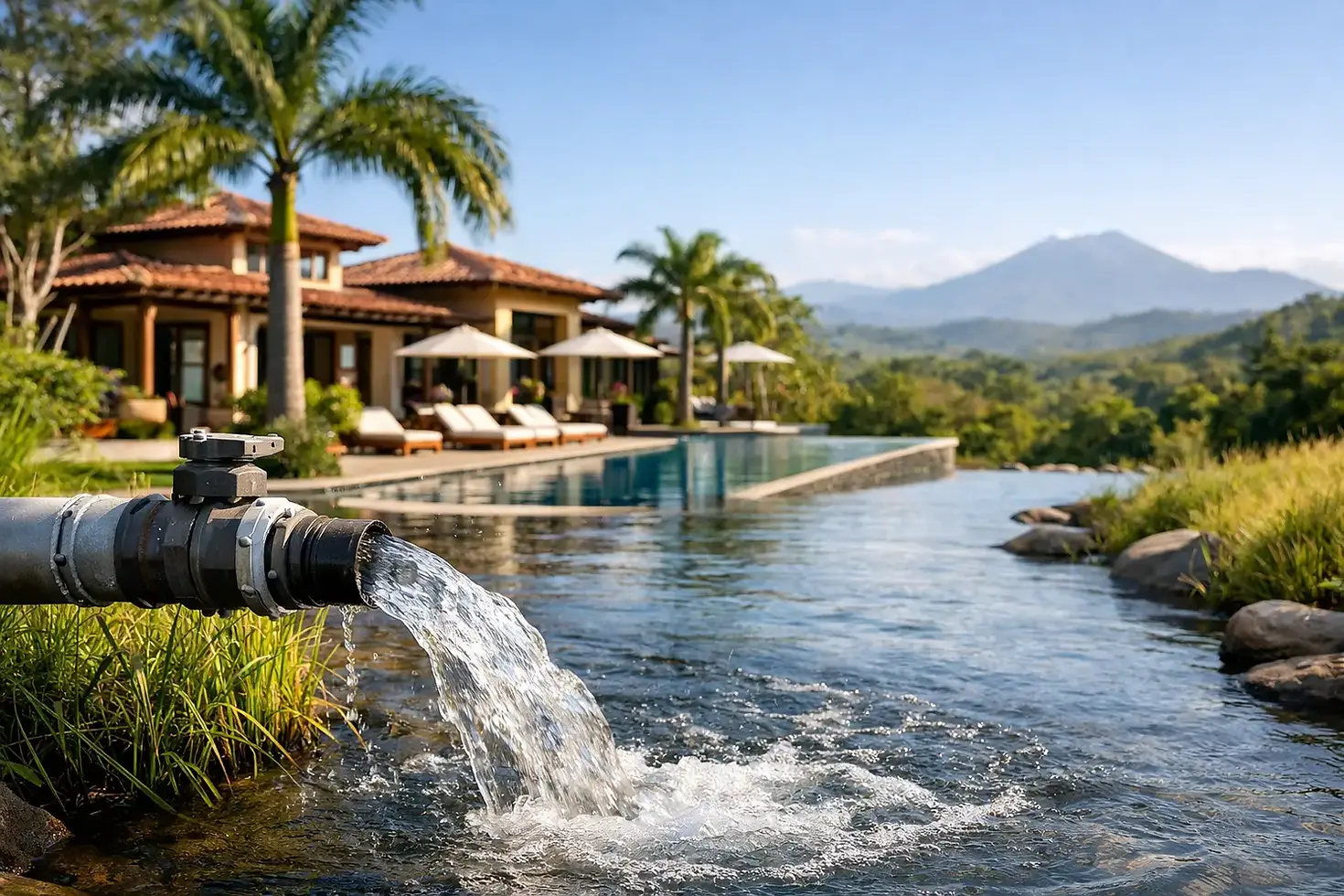
Guanacaste Water Rights and Luxury Property

A panoramic ocean view may be the first reason to consider a Guanacaste estate. Water is often the reason a discerning buyer decides whether to proceed. Guanacaste water rights are not a decorative detail in a property file. In Costa Rica’s dry northwest, they can shape a residence’s daily comfort, landscape design, rental potential, expansion plans, and long-term resilience.
For a buyer accustomed to acquiring premium homes in the United States, the terminology can initially feel unfamiliar. Water access in Costa Rica is not always represented by a single, transferable document attached neatly to a deed. It may involve a public utility connection, a community water association, a legally permitted private well, a concession, a registered easement, or a combination of systems serving a larger development.
The distinction matters. A legacy property should offer not only remarkable architecture and an exceptional setting, but also clarity around the resource that sustains its private lifestyle.
Why Guanacaste Water Rights Deserve Early Attention
Guanacaste has pronounced wet and dry seasons. During the driest months, demand rises from homes, hotels, agriculture, construction, and the region’s vibrant visitor economy. Coastal communities can face infrastructure constraints even where the market for premier estates remains highly desirable.
This does not mean every property without a private well is a compromised acquisition, nor does a well automatically make an estate superior. Many of the region’s most refined residences are served reliably by established public or community systems. The relevant question is more precise: what is the lawful source of water, what capacity is available to the property, and can that supply support the buyer’s intended use?
An estate designed for occasional seasonal use has different requirements from a multigenerational residence with guest casitas, mature tropical gardens, an infinity pool, staff accommodations, and a wellness pavilion. A buyer planning a future expansion should treat present water capacity as only one part of the analysis. The ability to secure additional supply can be as consequential as the supply already in place.
The Water Arrangements Buyers Commonly Encounter
Public Utility and Community Water Service
Many homes receive water through the national water and sewer utility, commonly known as AyA, or through an ASADA, a community-managed rural aqueduct association. In established coastal communities, this is often the most straightforward arrangement. The property may have an active meter, regular billing history, and an established connection.
Yet straightforward should not be confused with automatic. Buyers should confirm the account status, meter type, service history, pressure and continuity as appropriate, and whether the connection is formally tied to the parcel being acquired. For a home within a gated community, ask how supply is managed across the development and whether any communal storage, pumping, or backup systems are maintained by the homeowners association.
A dependable community system can be an elegant, low-maintenance solution. The trade-off is that its capacity and future expansion options may be governed by the provider and broader local infrastructure rather than solely by the estate owner.
Private Wells and Groundwater Use
A private well can offer meaningful independence, particularly for larger landholdings, irrigated grounds, or properties located beyond fully developed service areas. It can also be a point of complexity. A productive well is not, by itself, proof that the water source is properly authorized or that the use envisioned by a new owner is permitted.
Due diligence should examine well registration, drilling records where available, permits or concessions applicable to extraction and use, and evidence of lawful operation. The review should also consider the well’s physical condition, pump equipment, storage infrastructure, water quality testing, production history, and any restrictions that affect volume or intended use.
For an estate with extensive landscaping, ask whether irrigation is supplied by the well, potable service, reclaimed water where available, or a separate source. That answer influences operating costs and the quality of the landscape one can maintain through the dry season.
Water Concessions and Larger Holdings
Costa Rica treats water as a public resource. In certain circumstances, the right to use water is formalized through a concession or other administrative authorization rather than private ownership of the water itself. This is especially relevant for properties with springs, streams, significant groundwater extraction, agricultural components, or development ambitions.
A concession deserves a close review by qualified Costa Rican counsel and technical professionals. Its holder, duration, authorized use, permitted volume, source, payment status, and transfer implications all require attention. A concession that supports one use may not automatically support another. An authorization associated with agricultural irrigation, for example, should not be casually assumed to cover a future hospitality or residential expansion.
Water Delivery and Storage
In some locations, trucked water and on-site cisterns are part of normal operations, whether as a backup measure or a more central supply strategy. This can be entirely workable for a carefully managed residence, particularly when storage is generous and service is reliable. But it should be priced and understood as an operational commitment, not treated as a temporary inconvenience that will necessarily disappear.
For a luxury home, water storage, filtration, pressure systems, and backup power are part of the ownership experience. They are infrastructure, but they are also hospitality. A residence that performs gracefully when the region is at its driest protects the ease and privacy that make it exceptional.
A Better Due Diligence Standard for Premier Estates
Water review should begin before a buyer becomes emotionally committed to a property. By the time a private viewing reveals sunset terraces, sculptural pools, and a beautifully planted garden, the advisory team should already be asking questions about source, legality, capacity, and risk.
The most effective process brings legal and technical review together. Costa Rican real estate counsel can examine title, concessions, contracts, service documents, and regulatory status. An experienced engineer, hydrogeologist, or other appropriate technical consultant can assess well systems, water storage, production evidence, equipment condition, and the practical implications of the property’s terrain and planned use.
For a premier acquisition, the file should be capable of answering several essential questions:
What source or sources currently supply the home, and are they active and lawful?
Is there a current water meter, concession, permit, well registration, or service agreement associated with the property?
What capacity is documented, and what has actual usage looked like in the dry season?
Does the existing supply support pools, landscaping, guest accommodations, and any planned additions?
Are there restrictions, arrears, maintenance obligations, easements, or shared-system responsibilities?
If water service is interrupted, what storage and backup arrangements preserve the home’s operation?
The goal is not to turn a property search into a technical exercise. It is to ensure that the lifestyle represented by an estate is supported by the systems beneath it.
The Difference Between Existing Use and Future Potential
One of the most expensive assumptions in Guanacaste real estate is that a property’s existing water arrangement will accommodate future ambitions. A current residence may be fully compliant and well supplied for its present footprint, while a planned guest house, additional bedrooms, event space, or subdivision concept triggers a very different level of scrutiny.
This is particularly important for buyers drawn to acreage and legacy properties. Land creates possibility, but possibility must be matched by water availability, zoning, environmental requirements, wastewater planning, access, and construction approvals. No single water document should be viewed in isolation from that wider framework.
The answer may be favorable, but it depends on the parcel, municipality, service area, source, and intended use. A disciplined buyer investigates the future concept early enough to preserve negotiating leverage and avoid designing around an assumption that cannot be realized.
Water as a Measure of Enduring Value
At the luxury end of the market, scarcity is often discussed in terms of views, beachfront position, acreage, and architectural distinction. In Guanacaste, reliable and well-documented water access belongs in that conversation. It may not be visible from the terrace, but it can influence how confidently the property is enjoyed, improved, insured, marketed, and eventually passed forward.
A well-prepared seller will welcome informed questions and provide clear documentation. If records are incomplete, that does not always end the conversation. It simply changes the path forward, potentially requiring further investigation, corrective work, a revised valuation, or contractual protections before closing.
For buyers acquiring from abroad, the highest level of service is not merely arranging access to beautiful homes. It is helping ensure that the estate selected can sustain the life imagined within it. Papagayo Luxe approaches premier Guanacaste property with that same standard of considered stewardship: exceptional settings, carefully examined, and chosen with the future in view.
Before committing to a coastal retreat or a significant landholding, let the water story be as clear as the view. The right estate should offer not only a rare address, but the quiet confidence of infrastructure worthy of a lasting legacy.



Comments