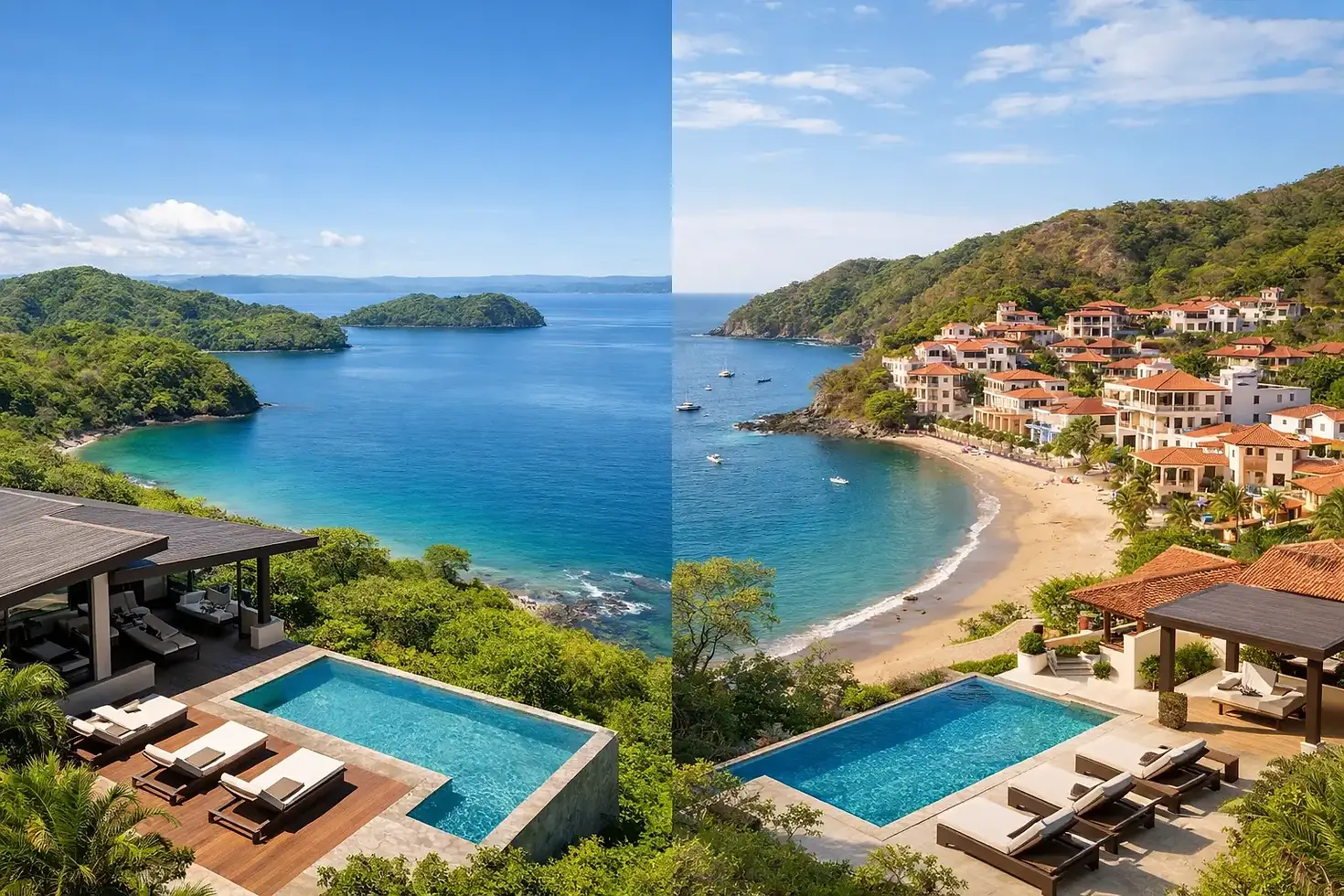
Papagayo Versus Las Catalinas Homes Compared

A Guanacaste residence can be many things: a private family sanctuary, an impeccably managed second home, a base for coastal adventure, or a lasting expression of discernment. The choice between Papagayo versus Las Catalinas homes is not simply a question of scenery. Both offer a rare standard of living on Costa Rica’s Gold Coast, yet they present two distinct interpretations of luxury.
Papagayo is defined by protected privacy, resort-caliber service, and dramatic homesites shaped by the peninsula’s coves, elevation, and sea views. Las Catalinas is defined by a walkable, architecturally composed town where daily life unfolds between the beach, plazas, trails, and restaurants. For a buyer considering a legacy property, the more compelling address depends on how the home will be lived in when the doors are closed and the guests have gone home.
Papagayo Versus Las Catalinas Homes: The Essential Difference
At Peninsula Papagayo, luxury is expansive and deliberately private. Residences are often positioned within a landscape of tropical dry forest, with ocean, bay, golf course, or peninsula views. The experience is tailored to owners who value space, controlled access, club amenities, and the ease of a highly serviced residential environment. A home here can feel removed from the world without being disconnected from it.
Las Catalinas approaches luxury through proximity. Its homes, villas, and residences are woven into a pedestrian-oriented coastal town on Playa Danta. The emphasis is on an active, social rhythm: an early walk for coffee, a morning swim, a trail run above the Pacific, and dinner within a few minutes of home. Its appeal lies in being part of a place with an immediate sense of community and visual coherence.
Neither is categorically superior. They serve different versions of an exceptional Costa Rican life. The more useful question is whether a buyer seeks a private resort estate or a residence embedded in a cultivated beach town.
The Papagayo Proposition: Privacy With a Resort Standard
Papagayo appeals to buyers who see real estate as both a personal retreat and an enduring family asset. Its residential offering tends to favor generous indoor-outdoor living, substantial terraces, infinity-edge pools, and architecture designed to frame the Pacific rather than compete with it. Many homes are intended for multigenerational use, with separate guest suites, entertaining areas, staff accommodations, and layouts that allow family and friends to gather without sacrificing privacy.
The setting is equally important. Peninsula Papagayo occupies a distinctive stretch of coastline, with access to beaches, marinas, golf, wellness, dining, and resort services that make ownership feel notably effortless. For a US-based owner, that operational ease can carry real weight. A residence that is carefully maintained, professionally managed, and ready for arrival allows more time to be spent enjoying Guanacaste rather than organizing it.
This is also a market where discretion matters. Some of the most significant estates do not receive broad public exposure, particularly when owners prioritize privacy or wish to control the sale process. The most meaningful opportunity may be a finished residence with an established pedigree, an exceptional homesite, or a quiet off-market offering that aligns precisely with a family’s preferences.
Papagayo’s trade-off is intentional. Its private, resort-centered character can feel less spontaneous than a traditional town. Owners who want to leave the house and immediately encounter local cafés, neighbors, and everyday street life may find its scale more secluded than they prefer. For others, that very separation is the point.
Who Is Best Suited to Papagayo?
Papagayo is especially compelling for buyers seeking a premier estate with a strong sense of arrival. It suits families who entertain extensively, owners who value a polished service environment, and investors whose definition of value includes irreplaceable location, controlled surroundings, and long-term prestige.
It can also be the more natural choice for those who divide their time among several global residences. The ability to arrive to a well-managed home, enjoy a complete amenity ecosystem, and depart with confidence in ongoing care is part of the ownership proposition.
Las Catalinas: A More Connected Coastal Life
Las Catalinas offers an entirely different kind of refinement. The community has been designed around human scale, traditional urban form, and the idea that the best parts of daily life should be close at hand. Its streets and paths encourage walking, and its architecture gives the town a composed, enduring character that differs from the more dispersed coastal development found elsewhere in Guanacaste.
For many buyers, that walkability is more than a convenience. It changes how a second home is used. Children and grandchildren can move more freely between the beach, shops, and shared spaces. Guests can enjoy an independent day without needing a vehicle or a formal itinerary. Owners can arrive for a long weekend and immediately feel part of the energy of the town.
Homes in Las Catalinas range from intimate residences to larger villas, often with courtyards, terraces, pools, and carefully considered views. The architectural language tends to reward buyers who appreciate design discipline and a sense of place. Rather than a standalone estate set apart from its surroundings, many properties derive part of their value from their relationship to the town itself.
The community’s access to beach and trail life is a particular advantage. For an owner who wants morning movement, casual dining, and an easy social atmosphere to be central to the experience, Las Catalinas can be difficult to replicate.
Who Is Best Suited to Las Catalinas?
Las Catalinas is often well matched to buyers who want a home that feels alive even during a short visit. It appeals to active families, design-minded owners, and those who value the ability to walk to the water, meet friends for dinner, or spend an afternoon on the trails without coordinating transportation.
It may also appeal to owners considering a residence with guest appeal. The town’s recognizable identity, beach access, and built-in lifestyle can make it attractive to visitors. Yet rental considerations should never overshadow the personal fit of the property. Rental rules, management arrangements, seasonal demand, ownership costs, and projected use should be examined property by property, not assumed based on a community’s reputation.
Architecture, Views, and the Meaning of Space
The visual distinction between these markets is clear. Papagayo homes often prioritize expansive private grounds and sweeping outlooks. The emotional impact comes from elevation, water, horizon, and the feeling that the property commands its own piece of the coast. For a buyer looking for a statement estate, this can be profoundly compelling.
Las Catalinas delivers a more intimate form of beauty. A residence may frame a view through a courtyard, open toward a plaza, or place the beach at the center of everyday life. The setting feels more interconnected, and the architectural experience is often as much about streetscape and community as it is about the home’s individual footprint.
Buyers should resist comparing square footage alone. A larger Papagayo home may offer a different type of luxury than a smaller but exceptionally positioned Las Catalinas residence. In both markets, the highest-value properties tend to combine enduring design, ease of access, a protected view corridor where applicable, and a setting that will remain desirable through changing cycles.
Access and Ownership Considerations
Both communities benefit from Guanacaste’s appeal to international owners and from proximity to Liberia’s international airport. Still, an in-person evaluation matters. The route from airport to residence, the feel of the surrounding coastline, the quality of the arrival experience, and the practical rhythm of a stay all influence whether an address feels right over time.
A disciplined acquisition process should also look beyond the home itself. Buyers should evaluate homeowners association obligations, architectural guidelines, property management options, ongoing maintenance requirements, insurance, title and corporate structuring, and any rental parameters that may affect intended use. In Costa Rica, qualified legal, tax, and real estate professionals are essential to a well-considered purchase.
This is where curated representation creates clarity. A short list of truly suitable properties is more valuable than a large inventory of possibilities. Papagayo Luxe approaches the search with that principle in mind: considering not only what is available, but what deserves a place in a client’s long-term portfolio.
Choosing the Address That Becomes Part of Your Story
Choose Papagayo when privacy, service, large-scale entertaining, and a protected resort setting are central to the vision. Choose Las Catalinas when walkability, architectural character, beach-town energy, and an active shared lifestyle are the stronger pull.
There is also room for more personal distinctions. A couple seeking quiet restoration may be drawn to Papagayo’s space and serenity, while a family with teenagers or frequent guests may favor Las Catalinas’ immediate activity. Conversely, a family that gathers in large groups may find Papagayo’s estate-style residences better suited to its traditions. The correct answer emerges from how ownership is intended to feel, not from a checklist alone.
The finest Guanacaste property is not merely the home with the grandest view or the most recognizable address. It is the one that receives your family naturally, reflects your standards without effort, and becomes more meaningful with every return.


Comments